Chemistry & Temperature · Tool 03
Water Temperature Mixer
About this calculator
If the water coming out of the faucet is clearly too cold or too hot, a quick calculation is more convenient than spending a long time adjusting it. The temperature mixer shows you the approximate amounts you'll need for your desired water bath or mixture.
You can also combine two existing amounts of water and calculate the expected temperature of the mixture. I would still check with a thermometer afterward, though: the container, room temperature, and the time it takes to pour the water are always factors to consider in practice.
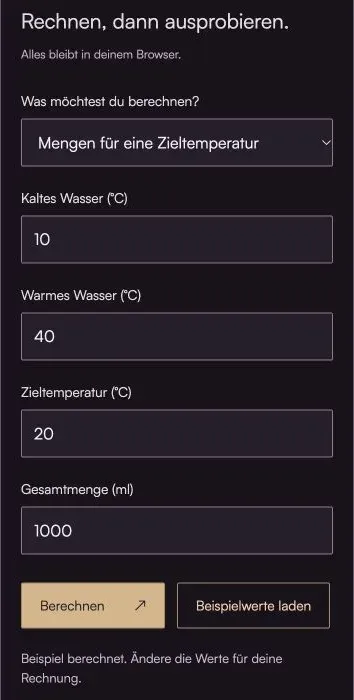
Do the math, then give it a try.
Everything stays in your browser.The calculator is loading …
Your result
100% / Select "Actual Size." Turn off headers and footers. Then check the 100-mm distance with a ruler.
How to Use the Calculator
- Check the temperature of the cold and hot water. The hot water really does have to be warmer.
- Choose between target temperature based on total quantity and available individual quantities.
- Mix the calculated amounts thoroughly and check the actual temperature before proceeding with the preparation.
What's Behind the Bill
Hot water = Total volume × (Target temperature − cold) / (hot − cold)
The warm water releases heat, while the cold water absorbs it. For water with approximately the same density and heat capacity, this results in a weighted average temperature. When the two volumes are equal, the theoretical mixed temperature lies exactly in the middle.
The calculation uses milliliters as a practical approximation for the volumes of water involved. It does not account for heat loss or the heat capacity of the bottle or bowl. The discrepancy may be noticeable, especially with small amounts or a very cold container.
This tool is designed for water. Solutions with different heat capacities, the dissolution of salts, or exothermic mixtures require different models. Therefore, do not use it to predict temperatures for arbitrary photochemicals.
An example to work through
To make 1,000 ml at 20 °C using water at 10 °C and 40 °C, you will end up with approximately 666.67 ml of cold water and 333.33 ml of warm water.
Here's what you should keep in mind
- The target temperature must be between the two initial temperatures.
- Range: 0 to 100 °C, excluding ice, evaporation, or phase changes. Significantly narrower temperature ranges are typical for darkrooms.
Frequently Asked Questions (FAQ)
How do I mix water to exactly 20 °C?
Measure the temperatures of both water samples and enter 20 °C as the target temperature, along with the total volume required. Mathematically, combining water at 10 °C and 40 °C yields 1,000 ml at 20 °C, consisting of approximately 666.67 ml of cold water and 333.33 ml of warm water. After mixing, stir and check the temperature with a thermometer.
Why does the measured mixture temperature differ from the result?
The calculator only takes into account the heat exchange between the volumes of water. The container and the surroundings also absorb or release heat; water also cools down during transfer. Using a preheated or temperature-matched container, working quickly, and mixing thoroughly can minimize these deviations.
Can I also use it to mix ice water or photo chemicals?
This model applies to liquid water without phase changes. Ice requires additional heat to melt and is not included. Other liquids and chemical solutions may have different heat capacities or release heat when mixed. Therefore, this water calculator is not a reliable tool for predicting temperature.
Read More & Sources
If you'd like to learn more about the basics, you'll find helpful explanations here.